
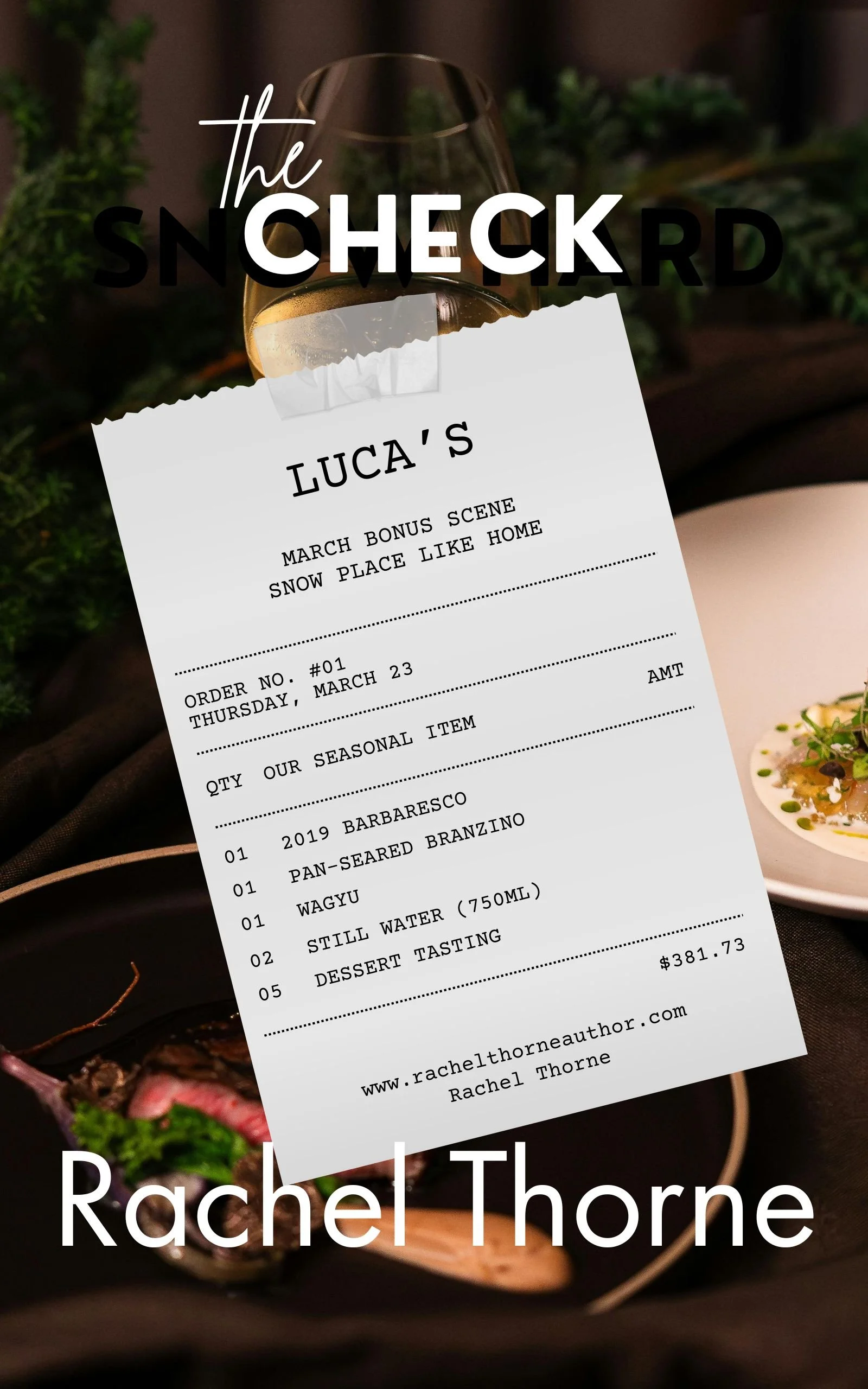
Snow Place Like Home
Bonus Scene
March: The Check
Finley and Alex
The dress is the first sign I’m in over my head.
It’s hanging on the back of my closet door—a deep green thing I bought at a consignment shop two years ago for a hospital holiday party I ended up not going to because I picked up an extra shift instead. It still has the tags on. Not the original tags. Consignment tags. Which feels like a metaphor for something, but I don’t have time to unpack that because Alex is picking me up in forty minutes and I haven’t shaved my legs yet.
He’d been cagey all week. Saturday night. Wear something nice. I’ll pick you up at seven. When I’d pressed for details, he’d just smiled and said, “It’s a surprise.”
I don’t love surprises. Surprises in my life have historically involved words like past due and we regret to inform you. But Alex looked so genuinely excited that I couldn’t bring myself to push back.
“You look like you’re going to prom,” Barb says from my doorway. She’s leaning against the frame in her housecoat, arms crossed, watching me wrestle with a zipper.
“I look like I’m going to a job interview at a funeral home.”
“You look beautiful,” Mirna calls from somewhere behind Barb. “Stop fussing.”
I turn sideways in the mirror. The dress fits better than I expected—it hits just below the knee and does something kind to my waist. My mother would have said I looked like Audrey Hepburn. My mother also thought I could sing, so her judgment wasn’t always reliable, but I’ll take the compliment from the beyond.
“Where’s he taking you?” Barb asks, stepping into my room and sitting on the edge of my bed. Maybelle immediately relocates to her lap, because Maybelle is a traitor.
“No idea. He just said ‘wear something nice.’”
Barb raises an eyebrow. “‘Wear something nice’ from a man who wears five-hundred-dollar shoes to get coffee.”
“They’re not five hundred—” I pause. They might actually be five hundred. I genuinely don’t know. “They’re just shoes.”
“Honey,” Mirna says, now visible in the doorway with a cup of tea. “Nothing that man owns is ‘just’ anything.”
She’s not wrong. And that’s part of what’s making my stomach tight as I clip on my mother’s small gold earrings and take one last look in the mirror.
***
Alex shows up at exactly seven, which I’ve learned is his thing. Not early, not late. Seven means seven. He’s in a charcoal sport coat over a white shirt, no tie, collar open. He looks like he just stepped out of one of those cologne ads where a man walks purposefully through a European city for no apparent reason.
He stops in the hallway when he sees me and does that thing where his eyes go soft and he forgets to close his mouth for a second.
“You look—”
“If you say ‘nice,’ I will turn around and put on sweatpants.”
He laughs. “I was going to say stunning.”
“Acceptable.” I grab my bag—a small clutch Bethany lent me that’s so tiny it can barely fit my phone and a lip gloss, let alone the emergency granola bar I usually carry. “Where are we going?”
“You’ll see.”
“Should I be worried?”
He takes my hand as we walk to his car. “When have I ever given you a reason to worry?”
I could make a list, but I keep it to myself.
***
The restaurant is called Luca’s, and I know it’s trouble the second we pull up because there’s a valet. In my experience, anywhere that parks your car for you is going to charge you forty-two dollars for a chicken breast.
Inside, it’s all exposed brick and candlelight and the kind of hushed conversation that makes you feel like everyone else got a memo you didn’t. The host greets Alex by name. By name. And leads us to a corner table by the window, where the city skyline glitters through the glass like it’s trying to show off.
Alex pulls out my chair. I let him, because he gets this quiet satisfaction from it that I’ve stopped fighting.
The menu arrives, and I open it.
No prices.
There are no prices on the menu.
I stare at it for a long moment, reading the descriptions. Pan-seared branzino with fennel pollen and citrus beurre blanc. Wagyu carpaccio with shaved black truffle. I know what about half of these words mean. Fennel is a plant, I think. Branzino is a fish. Beurre blanc is—actually, I have no idea what beurre blanc is, but it sounds like it costs more than my electric bill.
“See anything you like?” Alex asks, scanning his own menu like it’s perfectly normal to order food without knowing if you’re spending twenty dollars or two hundred.
“Still looking,” I say brightly. Still calculating, is more accurate. I’m trying to figure out what the least expensive thing might be based on ingredient complexity. Pasta is usually cheaper than steak. Appetizer portions are smaller, so they should cost less. But without prices, I’m navigating blind, and my internal calculator is spinning like a slot machine.
The waiter arrives. He’s the kind of waiter who introduces himself with his full name and then recommends a bottle of wine by region and vintage year like he’s narrating a documentary.
“The 2019 Barbaresco is exceptional tonight,” he says.
Alex nods. “We’ll take a bottle.”
A bottle. Not a glass. A bottle. Without even asking the price. I take a sip of water.
***
Here’s the thing: the dinner is beautiful.
Alex is relaxed in a way I don’t see often enough—laughing easily, telling me about a disastrous lunch meeting where Roland accidentally pitched the wrong slide deck to investors and didn’t notice for fifteen minutes. He reaches across the table and takes my hand between courses, rubbing his thumb across my knuckles like he’s memorizing them.
The food is incredible. My branzino—I went with the fish because it seemed like a safe middle-ground choice—is the best thing I’ve ever put in my mouth. The fennel pollen turns out to be this delicate, almost sweet dust that makes the whole plate taste like it was cooked by someone who actually loves food. I want to lick the plate. I do not lick the plate.
But there’s a quiet hum in the back of my brain the entire time. A calculation running on a loop. This wine. This table. This meal. I’m trying to enjoy the moment, and I mostly am, but part of me is already thinking about what happens next week, and the week after that.
Because Alex doesn’t do this as a special occasion. This is just… Saturday to him.
When the waiter brings dessert menus, Alex waves them off. “The chocolate soufflé,” he says. “Two spoons.”
I smile because it’s sweet. And because it means he’s comfortable enough with me to order without asking. And because a soufflé sounds amazing. But also because the ordering-without-asking thing is exactly the kind of small moment that’s been accumulating, like snow on a windshield. Each flake is nothing. But eventually, you can’t see the road.
The check arrives in a leather folder. Alex slides his card in without opening it.
Without. Opening. It.
I watch his hand sign the receipt and feel something tighten in my chest that has nothing to do with the wine.
***
We’re in the car, heading back toward my apartment, and the city lights are sliding across the windshield in streaks of white and gold. Alex has one hand on the wheel and the other resting on my knee, and a jazz station is playing something low and warm, and it’s the kind of perfect, cinematic moment where a normal person would lean her head back and feel happy.
I should feel happy.
I do feel happy. But there’s something else sitting right beside the happy, and it’s been sitting there all night, and if I don’t say it now, it’s going to calcify into something harder to remove later.
“I had a really wonderful time tonight,” I say.
He squeezes my knee. “Me too.”
“But I can’t do that every weekend.”
The car doesn’t swerve. His hand doesn’t leave my knee. But I can feel the shift—a tiny stillness, like the air in the car just held its breath.
“What do you mean?” he asks carefully.
“I mean—” I press my lips together. This is the part where I have to be honest without being hurtful, and those two things are harder to balance than people think. “That restaurant was amazing. The food, the wine, all of it. But Alex, a dinner like that costs more than I make in a week. Maybe two weeks.”
“I wasn’t expecting you to—”
“I know you weren’t. That’s not the point.” I turn slightly in my seat to face him. “The point is that I can’t reciprocate. When it’s my turn to plan a date, I’m not taking you to Luca’s. I’m taking you to the Thai place on Clairmont where the pad see ew is nine dollars and the tables wobble.”
He’s quiet for a few seconds, and I can see him thinking. Processing. Alex doesn’t do knee-jerk reactions anymore—that’s something that changed after Hollybrook. He used to deflect. Now he sits with it.
“I don’t care where we eat, Finley,” he says finally.
“I believe you. But I need you to understand something.” I take a breath. “When you take me to a place like that—and you pay without blinking—and then we go home to my apartment where the shower handle falls off once a week and Barb’s TV is so loud I can hear every plot twist of her telenovela through the wall—there’s a gap. And the gap isn’t about money. It’s about what I can bring to this.”
His jaw tightens. Not in anger. In that way he does when something hits him harder than he expected.
“You bring everything,” he says quietly.
“Alex.”
“I’m serious. You bring—” He stops. Starts again. “You brought me coffee on my launch day wearing your work apron, and it was the best part of my entire week. You think I need Luca’s?”
“No. But I think you’re used to it. And I think if I don’t say this now, three months from now I’m going to start feeling like your charity case, and then I’m going to start pulling away, and you won’t understand why, and it’ll get ugly for no good reason.”
The silence stretches. The jazz plays. A car honks somewhere in the distance.
“So what do you want to do?” he asks. And the way he says it isn’t defensive or wounded. It’s genuine. He wants to understand the rules of this thing we’re building, and he’s willing to let me draw some of the lines.
“I want us to take turns,” I say. “Your night, my night. And on my nights, we do what I can afford. No supplementing. No sneaking your card to the waiter. No ‘oh I just happened to already pay.’”
A small smile. “I would never.”
“You absolutely would.”
“…I might.”
“And on your nights,” I continue, “you can do whatever you want. Luca’s, rooftop bars, whatever. I’ll put on the green dress and eat the truffle things and feel like a queen. But I need to also be able to show you my life without feeling like it’s less than.”
He pulls up in front of my building and parks. Turns off the engine. The street is quiet—just the faint blue flicker of Barb’s television through her window and the buzz of the security light by the front entrance.
“Finley.” He turns to face me, and in the half-dark of the car, his eyes are serious. “Your life has never been less than. Not to me.”
“I know that. But the world disagrees, and the world is loud.” I think about Roland and the investors. The receptionist who thought I was Uber Eats. The waiter tonight who looked at my consignment dress and then looked at Alex like he was trying to solve a math problem. “I just need to know we’re building this on even ground. Even if the ground looks different on each side.”
He reaches over and takes my hand. Holds it. Doesn’t try to argue or fix or promise to make it all go away—which is what the old Alex would have done, the one I met in December who thought everything could be solved with a contract and a business plan.
“Okay,” he says. “Taking turns. Your night, my night.”
“Okay.”
“So when’s your night?”
I grin. “Next Saturday. And I’m not telling you where. Wear something comfortable.”
“Should I be worried?”
“When have I ever given you a reason to worry?”
He laughs—a real one, the kind that reaches his eyes—and leans across the center console to kiss me. It’s slow and warm and tastes like chocolate soufflé and expensive wine, and for a second I forget everything I was worried about.
***
He walks me to my door. The hallway smells like Mirna’s lavender oil and something Barb is baking—banana bread, maybe. These are the smells of my actual life, and they’re nothing like Luca’s, and I love them.
“For the record,” Alex says, leaning against my doorframe while I dig for my key, “I already know your night is going to be better than mine.”
“You don’t know that.”
“Yeah, I do.” He tucks a strand of hair behind my ear. “Because you planned it. And everything you touch turns into something worth showing up for.”
My throat goes tight. Not because it’s a line. Because it’s not.
I push open my door and pull him in by the front of his sport coat. “Get in here before Barb opens her door and makes you sit through banana bread and an interrogation.”
He grins and lets me tug him inside. Maybelle is sitting on the kitchen counter like she’s been waiting for a debriefing. She eyes Alex, hops down, and relocates to the armchair with the air of someone who’s seen this before and has no interest in watching it again.
Alex shrugs off his jacket and drapes it over the back of my kitchen chair—the one with the wobbly leg—like it belongs there. Like he belongs here. In my tiny apartment with the chipped tile and the fridge that hums too loud.
“So,” he says, loosening his collar. “Next Saturday. How comfortable are we talking? Jeans comfortable, or ‘bring a change of clothes’ comfortable?”
I laugh and kick off my shoes. “Jeans. And come hungry.”
He closes the distance between us, his hands settling on my waist. “Always.”
He kisses me—slower this time, without the center console between us, without the engine running, without anywhere else to be. His hand slides up my back and I lean into him, and the apartment is quiet except for the hum of the fridge and the faint murmur of Barb’s telenovela through the wall.
Later, after I’ve traded the green dress for an old T-shirt and Alex has stolen the left side of my bed like he always does, I lie in the dark and listen to his breathing slow. Maybelle has crept back and is curled at our feet, because she’s a hypocrite with no principles.
My apartment smells like banana bread and lavender and whatever cologne Alex wears that probably costs more than my rent. And I feel something settle in my chest that’s been restless for weeks.
Not fixed. Not resolved. Just… named. Acknowledged. Set on the table between us like something real.
Alex shifts in his sleep and pulls me closer, his arm heavy and warm across my waist.
And that’s enough for tonight.